Webflow Input Enhancer
For the best experience, this project uses the Webflow Input Enhancer extension. We highly recommend installing it. Click here to download (use preview mode to access link)
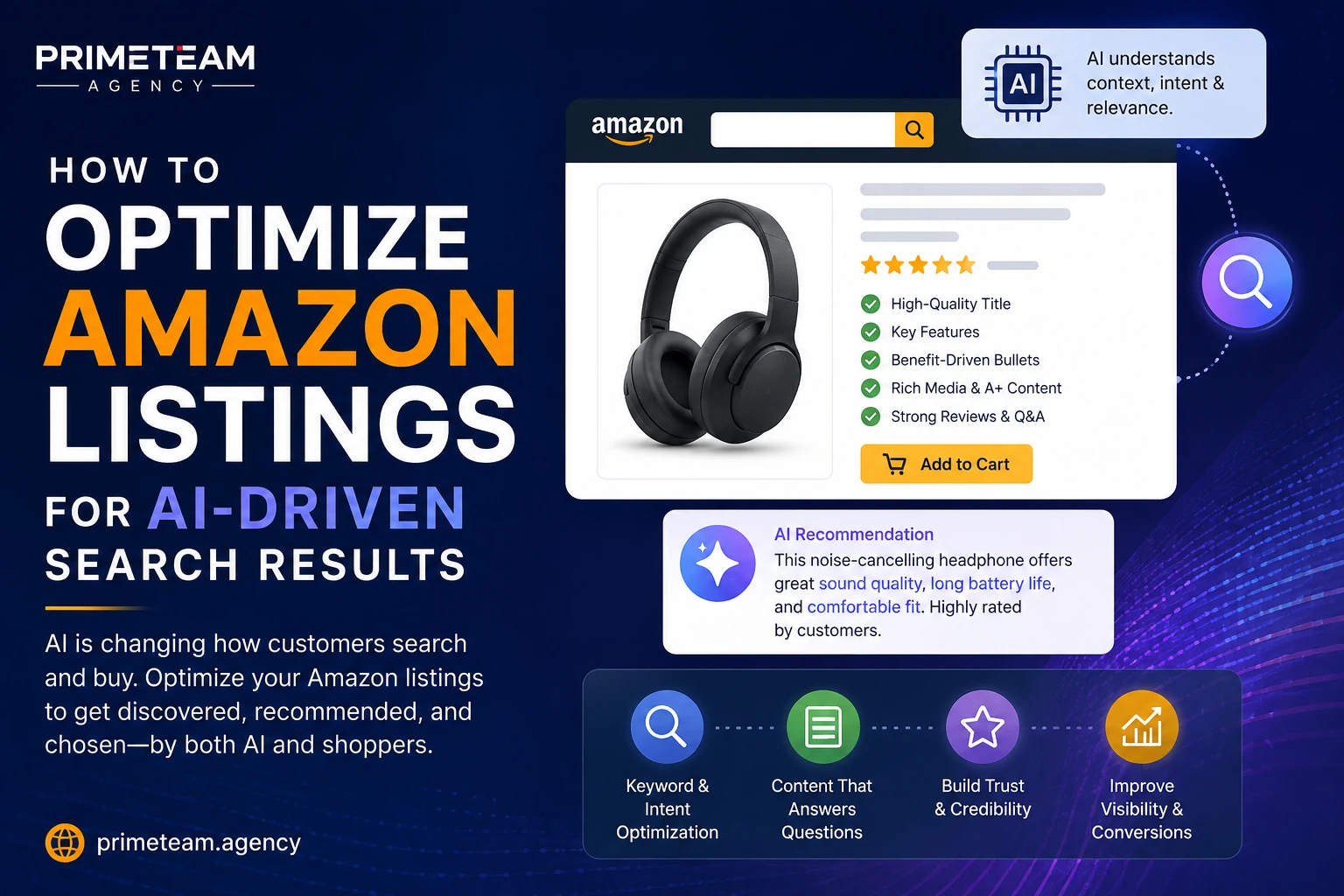
Amazon search is changing.
For years, sellers focused primarily on keywords, rankings, clicks, conversions, and sales velocity. Those fundamentals still matter, but shoppers are increasingly using AI-powered search and conversational shopping experiences to discover, compare, and evaluate products.
Amazon has introduced AI-powered shopping experiences that can answer natural-language questions, compare products, summarize product information, and help shoppers make purchase decisions. Amazon's Alexa for Shopping, for example, can provide AI-generated shopping guidance and product comparisons directly within the shopping journey.
This creates a new opportunity for sellers: Amazon listing optimization needs to be designed not only for traditional Amazon search, but also for AI-driven product discovery.
The goal is no longer simply to rank for "wireless headphones." Your listing should also provide enough clear, structured and relevant information for AI systems to understand questions such as:
This guide explains how to optimize Amazon listings for traditional Amazon SEO while making your product information more understandable to AI-driven search systems.
Amazon listing optimization is the process of improving a product detail page so that Amazon can better understand, match, rank, and present the product to relevant shoppers.
A typical Amazon listing includes:
Amazon itself recommends using relevant keywords throughout product listings while keeping the content useful and readable. Its keyword guidance specifically recommends researching customer search terms, incorporating them naturally into titles and bullets, and monitoring performance over time.
AI-driven search adds another layer.
Your listing should contain clear product facts, use cases, attributes, benefits and answers to common customer questions so that AI systems can understand the product beyond exact keyword matches.
Traditional search tends to work around queries such as:
"running shoes men"
AI-driven shopping is much more conversational:
"What are the best lightweight running shoes for men who run five miles every morning?"
The second query contains multiple concepts:
An AI system needs to understand the relationship between these concepts.
This means sellers should move from keyword-only optimization to intent and entity-based optimization.
Amazon's own AI listing tools demonstrate this shift. Amazon allows sellers to use generative AI to help create product titles, descriptions and other listing content from product information, images, URLs or spreadsheets.
However, AI-generated content should not simply be published without review. Sellers remain responsible for ensuring that product information is accurate and correctly represents the product.
Keyword research remains the foundation of Amazon SEO optimization.
But instead of creating a list containing only high-volume keywords, create a broader search-intent keyword universe.
For example, suppose you sell a stainless-steel water bottle.
Traditional keywords might include:
Expand these into conversational and long-tail searches:
Then classify keywords according to intent:
This approach creates content that can potentially match both conventional searches and conversational AI queries.
The product title remains one of the most important components of an Amazon listing.
Your title should communicate the product's identity quickly and clearly.
A strong structure is:
Brand + Product Type + Primary Keyword + Key Feature + Size/Quantity + Important Attribute
For example:
PrimeFit Stainless Steel Water Bottle, Insulated Leakproof Sports Bottle, 750ml, BPA-Free
The objective is not to insert every keyword.
Amazon specifically warns against keyword stuffing because excessive keyword repetition can create a poor customer experience and potentially hurt rankings.
For AI-driven search, make your title factually precise and semantically rich.
Instead of:
PrimeFit Bottle 750ml
Use:
PrimeFit Stainless Steel Insulated Water Bottle, Leakproof Sports Bottle, 750ml
The second title gives Amazon and shoppers much more product context.
Bullet points are one of the biggest opportunities for AI-friendly Amazon listing optimization.
Do not treat bullets as a place to repeat keywords.
Instead, use each bullet to answer a specific customer question.
Premium Water Bottle – High Quality Stainless Steel Bottle
Keeps Drinks Cold: Double-wall insulation helps maintain beverage temperature for workouts, travel and everyday use.
The second version communicates:
This gives AI systems more meaningful information to interpret.
A strong five-bullet framework can be:
Amazon recommends using bullet points to highlight important product details and customer-relevant features.
AI-driven search is fundamentally conversational.
Therefore, identify questions customers may ask before purchasing your product.
For a laptop, questions could include:
Your listing should contain factual information that answers these questions.
This is where Amazon GEO (Generative Engine Optimization) overlaps with traditional Amazon SEO.
Instead of optimizing only for:
"student laptop"
also provide information around:
"laptop for college students"
"laptop for online classes"
"lightweight laptop for students"
"laptop with long battery life"
The goal is not to force these phrases into your listing. The goal is to make the product's attributes, benefits and use cases explicit.
AI systems need reliable product information.
Make sure your Amazon listing contains accurate information about:
Amazon's listing guidance identifies product identity, product descriptions, bullet points, keywords and variations as important components of a product detail page.
Think of your listing as a product knowledge base.
The more accurately you define the product, the easier it becomes for Amazon's search and AI systems to understand where the product fits.
Backend search terms are still valuable for capturing relevant search variations that cannot naturally fit into visible listing content.
Consider:
However, don't duplicate everything already visible.
Amazon recommends using backend search terms for relevant keywords that aren't already included in the title, bullets or description.
The important principle is:
Cover semantic gaps, not keyword volume for its own sake.
Images are essential to ecommerce conversion, but they also provide contextual information about a product.
Use images to clearly demonstrate:
For example, if you sell a backpack, don't only show the backpack.
Show:
Your images and written content should reinforce the same product facts.
This creates a consistent product entity across the listing.
A+ Content provides additional opportunities to explain products through enhanced images, text, videos, comparison charts and other modules.
Amazon states that A+ Content can help brands showcase product details and brand stories, and Premium A+ Content can include features such as video, interactive hotspots, comparison charts and Q&A modules.
For AI-focused optimization, use A+ Content to answer deeper buying questions.
For example:
Comparison information helps shoppers understand differences quickly and gives your product page stronger contextual depth.
Customer reviews contain valuable search intelligence.
Analyze reviews for recurring phrases around:
For example, if customers repeatedly mention:
"comfortable for long flights"
you may have discovered a valuable use-case concept.
If the product genuinely supports that use case, incorporate it into your listing.
Do not manufacture claims simply because customers mention them.
Reviews should inform your optimization strategy, not become a source of unsupported claims.
A scalable Amazon listing optimization strategy can follow this workflow:
Collect:
Group terms into:
Improve:
Ask:
Track:
Then continuously improve your highest-value ASINs.
Avoid these common mistakes:
Keyword stuffing
Repeating the same keyword doesn't make a listing AI-friendly.
Generic AI-generated copy
AI can create content quickly, but generic content often lacks product-specific details.
Unsupported claims
Never add features, certifications, performance claims or specifications that aren't accurate.
Ignoring customer questions
Conversational search requires conversational answers.
Incomplete attributes
Missing product information reduces the amount of context available to shoppers and search systems.
Treating A+ Content as decoration
Use A+ Content to explain, compare and demonstrate—not just make the page look attractive.
Optimizing only for rankings
The ultimate objective is qualified traffic and sales, not simply keyword positions.
The future of Amazon SEO isn't about abandoning keywords.
It's about moving beyond keyword matching toward product understanding.
AI-powered shopping experiences are increasingly capable of interpreting natural-language questions and helping consumers compare products. Amazon's own AI shopping features demonstrate this shift toward conversational product discovery.
That means the strongest listings will combine:
Keyword relevance + Product entities + Search intent + Structured attributes + Buyer questions + Clear benefits + Conversion-focused content
For Amazon sellers, this creates a new opportunity.
Instead of asking:
"How many times should I use my primary keyword?"
ask:
"Does my listing give Amazon enough accurate information to understand why this product is relevant for a specific shopper?"
That's the foundation of AI-ready Amazon listing optimization.
Amazon listing optimization in 2026 requires both traditional Amazon SEO and AI-search thinking.
Start with keyword research, but don't stop there. Build comprehensive product information, optimize titles and bullets around search intent, strengthen backend search terms, use A+ Content strategically, analyze customer questions and reviews, and make every important product attribute explicit.
The objective is simple:
Make your product easy for shoppers to understand—and easy for Amazon's AI systems to understand, retrieve, compare and recommend.
For brands that want to scale Amazon visibility, combining Amazon SEO, conversion optimization and GEO can create a much stronger long-term marketplace growth strategy.
Q. How do I optimize an Amazon listing for AI search?
Ans. Optimize your Amazon listing with relevant keywords, clear product attributes, specific benefits, use cases, customer questions, accurate specifications, strong bullet points, backend search terms and detailed A+ Content. Focus on making the product easy for both shoppers and AI systems to understand.
Q. What is Amazon listing optimization?
Ans. Amazon listing optimization is the process of improving a product's title, bullets, description, images, attributes, backend keywords and A+ Content to improve search visibility, relevance, conversion and sales.
Q. What keywords should I use for Amazon SEO?
Ans. Use a combination of high-relevance primary keywords, secondary keywords, long-tail keywords, synonyms, product attributes, benefits, use cases and conversational search phrases. Amazon recommends researching the terms customers actually use when searching for products.
Q. How can I optimize Amazon listings for Rufus?
Ans. Make your listing information clear, accurate and comprehensive. Include product features, benefits, specifications, use cases, compatibility information and answers to common shopping questions so conversational AI can better understand the product.
Q. What is Amazon COSMO optimization?
Ans. Amazon COSMO optimization refers to improving product information so Amazon's semantic search systems can better understand relationships between products, attributes, customer intent and shopping behavior. The practical approach is to build comprehensive, accurate and semantically relevant product information rather than relying only on exact-match keywords.
Q. Does A+ Content help Amazon SEO?
Ans. A+ Content can strengthen the product detail page by providing additional product information through text, images, videos, comparison charts and other rich modules. Amazon describes A+ Content as a tool for helping shoppers make more informed purchasing decisions and supporting brand and sales goals.
Q. How many keywords should I use in an Amazon listing?
Ans. There is no universal ideal keyword count. Prioritize relevant keywords and cover important search intents naturally across the title, bullets, description, attributes and backend search terms. Avoid keyword stuffing because excessive repetition can hurt readability and customer experience.
Q. How do I improve my Amazon product ranking?
Ans. Improve keyword relevance, listing quality, click-through rate, conversion rate, customer experience, product information and sales performance. Start with keyword research and listing optimization, then continuously monitor search and sales performance to identify opportunities.
Q. Can AI write my Amazon product listing?
Ans. Yes. Amazon provides generative AI features that can help sellers create product listing content, including titles and descriptions, from information such as images, URLs and spreadsheets. However, sellers are responsible for reviewing the generated content and ensuring that product information is accurate.
Q. What is the difference between Amazon SEO and Amazon GEO?
Ans. Amazon SEO focuses primarily on improving product visibility and relevance within Amazon's search ecosystem. Amazon GEO focuses on making product information understandable and useful for generative AI and conversational shopping experiences. The strongest strategy combines both: keyword optimization with comprehensive, accurate, semantically rich product information.
Contact Prime Team Agency today to optimize your Amazon listings for AI-driven search results.