Risks of Amazon 1P Pricing Strategy: What Brands Need to Know
03 June 2026
By Brandon Fishman
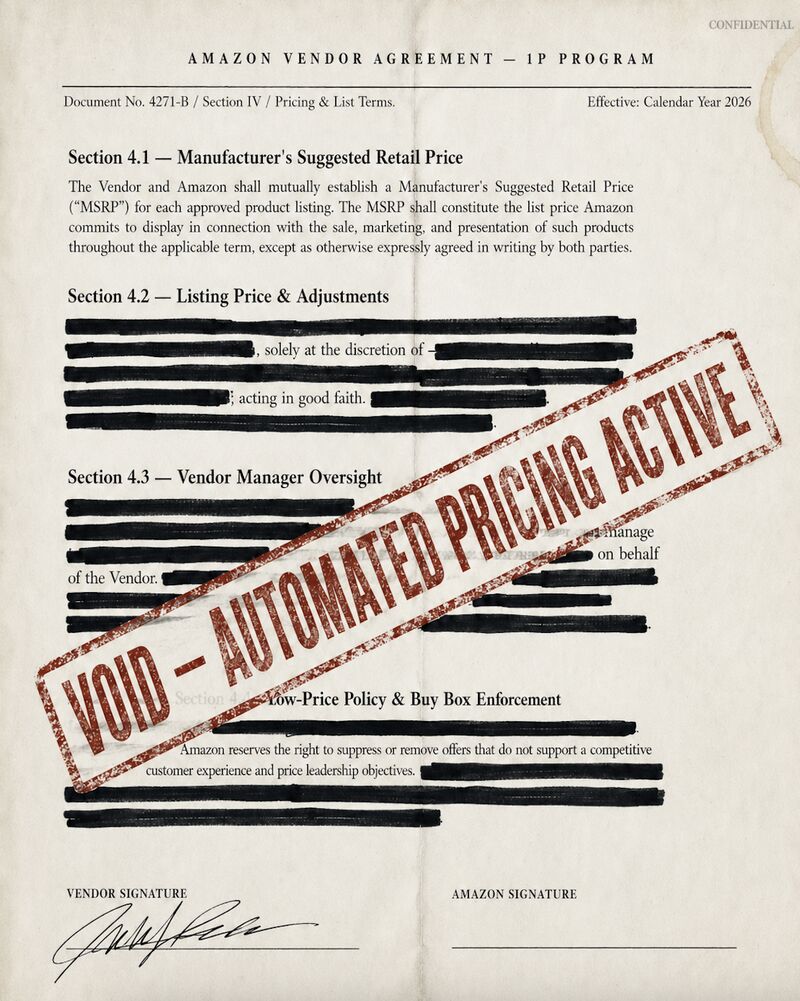
Amazon 1P (First-Party) pricing strategy refers to how Amazon determines retail prices for products purchased through Amazon Vendor Central. In the 1P model, Amazon acts as the retailer, buying inventory directly from brands and then setting the final selling price for consumers.
Unlike Amazon 3P sellers who control their own pricing, brands operating through Vendor Central typically have limited influence over retail pricing decisions.
While this model offers operational simplicity and access to Amazon's vast customer base, it also introduces significant risks related to profitability, brand value, and channel management.
For many consumer brands, Amazon is no longer just another sales channel. It has become a primary revenue driver, influencing customer expectations, market pricing, and retailer relationships.
As a result, pricing decisions made on Amazon often affect an entire business ecosystem.
A discount applied to a product listing can influence:
This is why Amazon pricing strategy has become one of the most important considerations for brands operating through Vendor Central.
The challenge is that in the 1P model, brands frequently lose direct control over that strategy.
When Amazon purchases inventory through Vendor Central, it generally determines the final retail price.
Amazon's pricing algorithms continuously evaluate:
The goal is simple: offer customers competitive pricing.
However, Amazon's objectives do not always align with a brand's profitability or positioning goals.
A premium product may be discounted to improve conversion rates, even when the brand is attempting to maintain premium market positioning.
Pricing is one of the strongest signals of product value.
When Amazon repeatedly lowers prices, customers begin associating the product with those discounted prices rather than its intended value.
Over time, this can make future price increases more difficult and weaken brand equity.
One of the most common Amazon Vendor Central challenges is margin erosion.
When Amazon lowers retail prices, other retailers often respond by matching those prices.
This can create a chain reaction:
Brands may continue seeing revenue growth while overall profit shrinks.
This issue is particularly common in competitive categories such as:
Yes.
Amazon constantly monitors pricing across the internet.
If a retailer offers a lower price than Amazon, Amazon may view the product as uncompetitive.
Potential consequences include:
Many brands unintentionally create Amazon performance problems by offering aggressive pricing to retail partners without considering the downstream impact on Amazon's ecosystem.
This is one of the most overlooked risks of Amazon 1P pricing strategy.
Brands selling through multiple channels often face retailer pushback when Amazon aggressively discounts products.
Retailers frequently ask:
"Why should we maintain higher prices if Amazon is selling the same product for less?"
This can lead to:
Over time, channel conflict can become a significant barrier to growth.
Consumers associate pricing with quality.
Premium brands rely on pricing consistency to reinforce value and differentiation.
Repeated discounts can create several challenges:
When customers consistently see discounted pricing, they often begin waiting for future promotions rather than purchasing at full price.
This weakens long-term pricing power.
Amazon's ecosystem is heavily influenced by promotional events such as:
While these events can drive significant sales spikes, they can also create long-term dependency.
Brands become reliant on discounts to generate demand.
Customers become conditioned to wait for deals.
Profitability suffers as promotional frequency increases.
The strongest brands use promotions strategically rather than as a primary growth mechanism.
Amazon prioritizes inventory efficiency.
If inventory levels exceed expectations, Amazon may lower prices to accelerate sell-through.
Although this benefits Amazon's operational goals, it can negatively affect:
This is a common challenge for brands with seasonal products or slower-moving inventory.
Global brands often sell across multiple Amazon marketplaces.
Pricing changes in one region can influence:
Maintaining pricing consistency becomes increasingly difficult as marketplace complexity grows.
There is no universal answer.
Amazon 1P works well for brands seeking:
Amazon 3P often appeals to brands seeking:
Many sophisticated brands now operate hybrid models that combine both approaches.
Amazon Vendor Central can be an effective growth channel, but brands should fully understand the trade-offs before relying heavily on the 1P model.
The biggest risks include:
For modern brands, pricing is not simply a revenue lever. It is a strategic asset that influences profitability, customer perception, retailer relationships, and long-term growth.
Before committing to an Amazon 1P strategy, brands should evaluate whether the operational benefits outweigh the potential pricing risks and determine how much control they are willing to give Amazon over their business.
Q. What is Amazon 1P pricing strategy?
Ans. Amazon 1P pricing strategy refers to the pricing model used in Amazon Vendor Central, where Amazon purchases products directly from brands and determines the final retail price for customers. Unlike Amazon 3P sellers, brands operating as first-party vendors typically have limited control over how their products are priced on the marketplace.
Q. Why do brands lose pricing control on Amazon Vendor Central?
Ans. Brands lose pricing control on Amazon Vendor Central because Amazon acts as the retailer after purchasing inventory. Amazon uses automated pricing algorithms that consider competitor prices, customer demand, inventory levels, and conversion rates to set retail prices, which may not always align with a brand's pricing objectives or profitability goals.
Q. How does Amazon 1P pricing affect profit margins?
Ans. Amazon 1P pricing can reduce profit margins when aggressive discounting creates pricing pressure across other sales channels. Retailers, distributors, and marketplace sellers may match Amazon's lower prices, leading to margin compression and reduced profitability for the brand as a whole.
Q. Is Amazon 3P better than Amazon 1P for pricing control?
Ans. Amazon 3P generally provides greater pricing control because brands and sellers set their own retail prices through Seller Central. However, Amazon 1P may offer advantages such as operational simplicity, wholesale purchase orders, and broader retail distribution. The best model depends on a brand's growth strategy, profitability goals, and operational capabilities.
Q. How can brands reduce Amazon 1P pricing risks?
Ans. Brands can reduce Amazon 1P pricing risks by diversifying sales channels, monitoring pricing across retailers, enforcing MAP policies where applicable, strengthening brand positioning, and evaluating hybrid 1P/3P strategies. Regular pricing audits and proactive channel management can also help protect profitability and maintain pricing consistency.
Looking for an Amazon agency? See how our Amazon agency team runs ads, listings, creative and reporting for established brands, or contact our team.
Follow on Linkedin for More Stories